
Metaxas, Eric. Letter to the American Church. Salem Books, 2022.
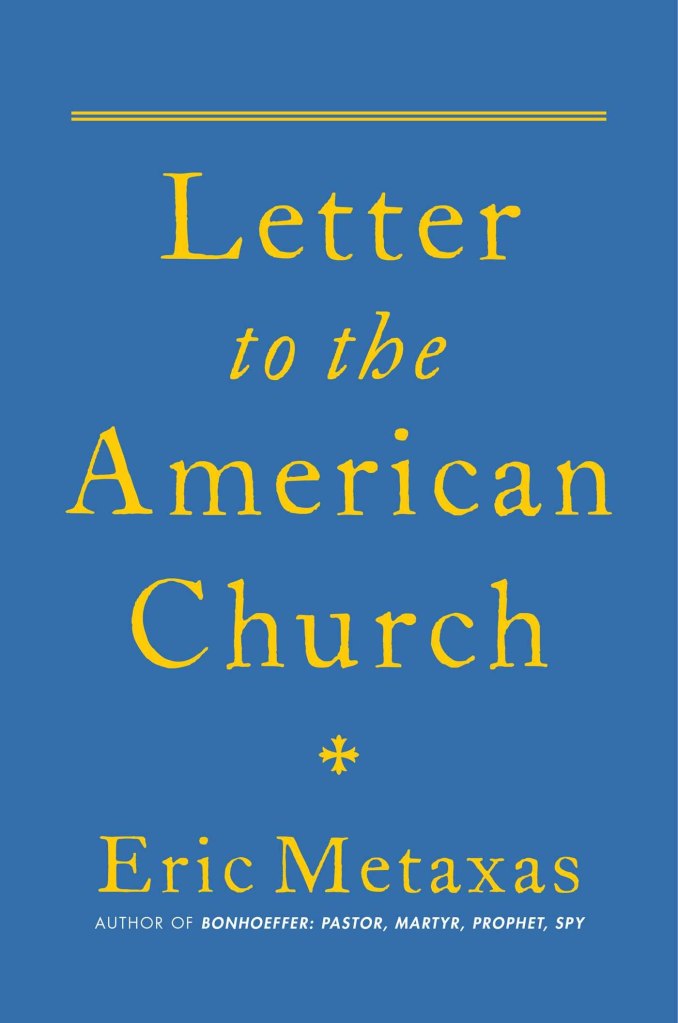
In Letter to the American Church, Metaxas seeks to sound the alarm that the American church is guilty of silence in the face of dangerous political and cultural threats that is akin to the silence and complicity of the German Church during the rise of Nazism in 1930s Germany.
He identifies the political and cultural threat to be the rise of globalism and an atheist Marxist ideology that leads to Critical Race Theory, radical transgenderism, and a pro-abortion agenda (xii).
He identifies four errors contributing to the silence of American pulpits in response to these threats including the following: (1) misunderstanding “faith” as something like Bonhoeffer’s “cheap grace” that has no ethical implications, (2) the “idol of evangelism” which leads church’s to think that the only “real role” for the church is evangelism, (3) a view of the relationship between church and state that prohibits involvement of the pulpit in political matters, and (4) a pietistic and personal view of “faith” that focuses on avoiding sin and developing virtue (Metaxas, 53-54).
In My View:
Metaxas is a writer and thinker who I respect and have benefited from greatly. I think his burden for the church and nation is authentic and mutually shared. I think his call to be more involved in the political moment of today is correct and timely for Christians in general. I think he is rightly reading the shift in American culture from a time when the culture supported religiosity in general and Christian morality in particular to a time when the culture is ambivalent to religiosity in general and hostile to Christian morality in general. This change in context requires a change in posture that the American Church has not had to face, yet it is the far more common posture for the Global Church. Rather than wring our hands in fear, the American Church can learn from our Global brothers and sisters while seeking to winsomely and compellingly persuade our fellow Americans of Christianity’s benefit to our society.
Metaxas’ emphasis on “silence” seems to indicate that his true burden is not for the American Church but rather for the American Pulpit. He seems to want pastors to speak up on the issues about which he rightly cares from the pulpit. His book could have been better entitled, Letter to the American Pastor. Here, the water is more murky. Baptists in particular and Protestants in general have been hesitant to involve the church in political lobbying while not at all hesitant (at least in theory) in advocating for Christian morality. This is largely due to a friendly relationship with the civil governing structures which shared conceptual, philosophical, religious, and even linguistic ground with the Protestant Church. By way of contrast, the African-American pulpit has not observed this hesitancy historically and was a significant force for mobilizing political action among church goers in the Civil Rights movement. The risks associated with identifying the Pulpit with politics are significant and arguably led to the downfall and near disappearance of Mainline Protestantism (see Kelley, Why Conservative Churches are Growing: A Study in Sociology of Religion with a New Preface, 1996 in Keller, “The Decline and Renewal of the American Church” 2021). Pastors must be cautious to protect the Pulpit’s voice as representative of God and His agenda rather than being coopted by any particular political agenda. The primary way that is expressed in my church is by expositional preaching through the Bible and addressing cultural and social matters as they are encountered in the biblical text rather than in the news.
Metaxas paints with too broad a brush to be convincing. The “church” which Metaxas describes and seeks to address does not match my church nor the churches with which I am familiar. While observing the historic, Baptist posture of limiting political advocacy from the pulpit, the Christians I know are deeply involved in and concerned about politics and the direction of our culture. In addition, the emphasis on evangelism, piety, and social action are friends of the effort to confront both globalism and Marxism because all three require involvement with neighbors, churches, and friends.
Metaxas’ comparison of the American Church to the German Church of the 1930s is stretched beyond recognition. If anything, this criticism could have been leveled at the slim minority of the “church affiliated” (I say “church affiliated”, not church goers or even Christians, so as not to insinuate any necessary connection between the actual American church and those who claim affiliation while acting without any theological or ethical identification with the church) who supported the violent disruption of the peaceful transfer of power on January 6, 2020. The Nazis were a personality-driven, pro-nationalism movement much more like the worst elements of Trump supporters than like the globalists and Marxists in American politics. For the book to be more persuasive, he would need to show how armed support for Trump is not the same as the support for the Nazis by German churches. That being said, I think Metaxas is identifying real threats not just to the “American way of life,” but to Christian life that do require a robust, nuanced, and sustained response. Christian education has long been the initiative to extend Christian morality into the future, and it strikes me that a renewed emphasis on it may be part of the way forward.
 Think These Things